
 Log in
 Sign up
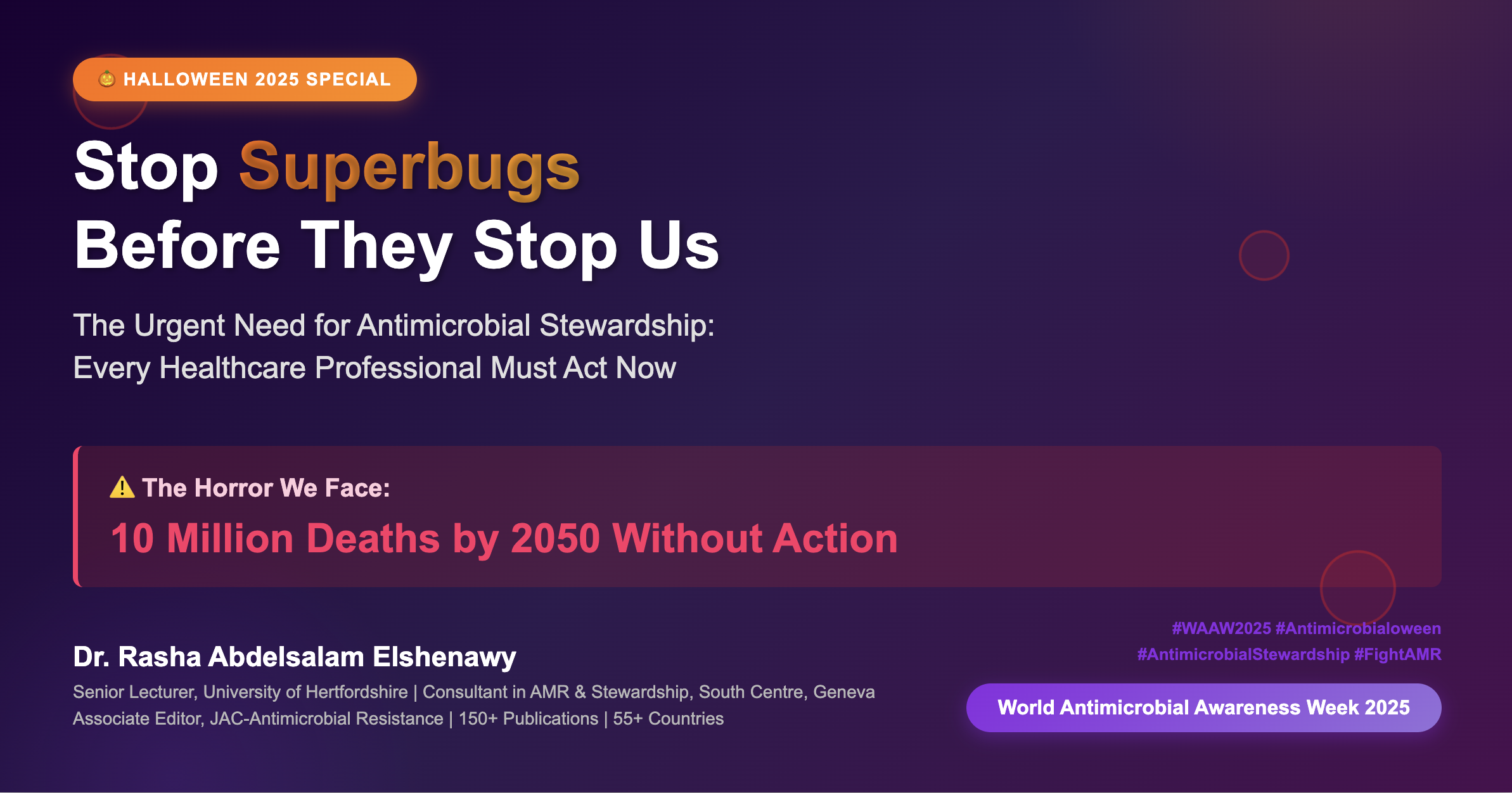
Antimicrobial Stewardship in 2025: Why Healthcare Professionals Must Act Now to Stop Superbugs This Halloween

Antimicrobial Stewardship in 2025: Why Healthcare Professionals Must Act Now to Stop Superbugs This Halloween
Dr. Rasha Abdelsalam Elshenawy
Senior Lecturer in Antimicrobial Stewardship, University of Hertfordshire
Consultant in AMR and Stewardship, South Centre, Geneva
31 October 2025
Last Halloween, I warned you about the nightmare of antibiotic misuse. This year, the threat is more urgent than ever. But there’s hope—if healthcare professionals across all disciplines unite in evidence-based antimicrobial stewardship.
As we mark World Antimicrobial Awareness Week 2025, antimicrobial resistance (AMR) continues to haunt our hospitals, clinics, and communities worldwide. The difference between horror and hope lies in one critical action: implementing robust antimicrobial stewardship programs now.
The Urgent Reality: Why Antimicrobial Stewardship Can’t Wait
The numbers don’t lie—and they’re terrifying. AMR is projected to cause 10 million deaths annually by 2050, a death toll exceeding that of cancer. By 2030, AMR could push 24 million people into extreme poverty. Healthcare costs related to resistant infections are already in the billions globally, while common infections are becoming untreatable with standard antibiotics. Routine surgeries and cancer treatments now face unprecedented risks.
But here’s what keeps me up at night: we already have the solutions. The tragedy isn’t that we don’t know what to do—it’s that we’re not doing it fast enough or consistently enough.
What Is Antimicrobial Stewardship? A Lifeline for Healthcare
Antimicrobial stewardship (AMS) isn’t just another healthcare buzzword—it’s our most powerful weapon against superbugs. Think of it as a coordinated defense system that ensures antibiotic safety, with regards to the right antibiotic is prescribed at the right dose and duration, at the right time, for the right infection, via the right route of administration.
Through my work consulting for the South Centre in Geneva- 55+ countries member states, exploring the WHO AMR Surveillance tools, and antimicrobial stewardship AWaRe guidelines, I’ve seen firsthand that effective AMS programs don’t just reduce resistance—they save lives, reduce healthcare costs, and improve patient outcomes.
Evidence-Based Prescribing: The Foundation of Effective Stewardship
My 22+ years of clinical and research experience have taught me one fundamental truth: evidence-based prescribing is non-negotiable.
Diagnostic Stewardship Comes First
Don’t guess—test. Rapid diagnostics and appropriate cultures guide targeted therapy. Our research in NHS Foundation Trusts during the COVID-19 pandemic showed that facilities with strong diagnostic protocols maintained better prescribing practices even during crisis conditions. The era of empiric therapy without follow-up investigation must end.
Clinical Guidelines and Classifications Matter
The WHO AWaRe (Access, Watch, Reserve) classification isn’t optional—it’s essential. Our studies demonstrate that implementing AWaRe reduces inappropriate broad-spectrum antibiotic use significantly while maintaining excellent patient outcomes. Access antibiotics should be first-line choices for common infections. Watch antibiotics require clear justification and documentation. Reserve antibiotics need expert approval and should be protected for last-resort situations.
Review and Optimise Continuously
Start smart, then focus. Initial empiric therapy is fine, but review at 48-72 hours is mandatory. My research on antibiotic review timing across 640 patients in UK hospitals revealed that timely reviews dramatically improved outcomes and reduced unnecessary broad-spectrum use. This isn’t a suggestion, it’s a critical safety measure that prevents resistance development and improves patient care.
Documentation Drives Accountability
Every antibiotic prescription should answer three questions: Why this antibiotic? Why does this do? Why this duration? Documentation isn’t bureaucracy; it’s the foundation of quality improvement and enables meaningful audit and feedback that changes prescribing behaviour.
Lessons from the Pandemic: A Wake-Up Call for Healthcare
My recent policy brief for the South Centre, “Lessons from COVID-19: Strengthening Antimicrobial Stewardship Prior to and During the Pandemic,” revealed a chilling pattern: pandemics amplify antimicrobial resistance.
The pandemic brought massive increases in inappropriate antibiotic prescribing for viral infections, widespread azithromycin overuse despite lack of evidence, disruption of established AMS programs, and breakdown in antimicrobial stewardship review processes. Yet facilities with robust AMS programs maintained better practices. Infection prevention measures reduced some healthcare-associated infections, digital health solutions proved invaluable for remote antimicrobial stewardship support, and multidisciplinary collaboration strengthened when properly supported.
The lesson is clear: we must build antimicrobial stewardship infrastructure before the next crisis, not during it. Waiting until we’re overwhelmed is too late.
Every Healthcare Professional Has a Role: United Against Resistance
Through my work providing written evidence to the UK Parliament Science, Innovation and Technology Committee on AMR policy and training over 200 healthcare practitioners through the FADIC Antimicrobial Stewardship School, I’ve learned that fighting AMR requires every healthcare professional.
Physicians or Doctors: The Prescribing Gatekeepers
Physicians hold the pen that writes antibiotic prescriptions, making them critical gatekeepers in antimicrobial stewardship. Following evidence-based guidelines for antibiotic selection isn’t just good practice—it’s essential for patient safety. Every prescription requires documentation of indication, dose, and planned duration. The 48-72 hour review isn’t optional; it’s when you reassess based on clinical response, culture results, and the patient’s evolving condition. Active engagement in antimicrobial stewardship programs and patient education about appropriate antibiotic use completes the physician’s stewardship role.
Pharmacists: The Stewardship Champions
Pharmacists bring unique expertise to antimicrobial stewardship through prospective audit and feedback, expert consultation on antibiotic selection and dosing, and leadership of antimicrobial stewardship interventions. Their role in monitoring for drug interactions and adverse effects, combined with their involvement in developing and implementing local antibiotic guidelines, makes them indispensable stewardship team members. In my research across NHS trusts, pharmacist-led interventions consistently showed the highest rates of appropriate prescribing changes.
Nurses: The Frontline Defenders
Nurses are often the first to notice when something isn’t working. Ensuring timely antibiotic administration, monitoring patient response, and reporting concerns quickly can make the difference between success and treatment failure. Rigorous infection prevention and control practices reduce the infections that require antibiotics in the first place. Nurses also play a crucial role in collecting appropriate cultures before antibiotic initiation and advocating for antimicrobial stewardship at the bedside, where they spend the most time with patients.
Microbiologists: The Intelligence Responsible
Clinical microbiologists provide the intelligence that guides our battle against resistance. Rapid diagnostic support, reporting of local resistance patterns, and guidance on empiric therapy recommendations transform abstract guidelines into practical, context-specific advice. Their role in educating on appropriate specimen collection and leading antimicrobial resistance surveillance creates the data foundation that makes evidence-based stewardship possible.
Infection Prevention Teams: The Shield Bearers
The best antibiotic is the one you never need to prescribe. Infection prevention teams prevent the infections that require antibiotics through healthcare-associated infection monitoring, evidence-based prevention bundles, outbreak investigation and control collaboration, and rigorous hand hygiene and isolation protocols. My research consistently shows that strong infection prevention correlates with better antimicrobial stewardship outcomes.
Digital Health: The Future of Antimicrobial Stewardship
As someone deeply involved in AI and digital health innovation for antimicrobial stewardship, I can tell you: the future is digital, and it’s here now.
Our proposed SMART-AMS (Stewardship Monitoring and Antimicrobial Resistance Tracking) dashboard development demonstrates how technology transforms stewardship. Real-time monitoring of prescribing patterns allows immediate intervention when inappropriate prescribing occurs. Data visualisation for clinical decision-making turns complex resistance data into actionable insights. Automated alerts catch inappropriate prescribing before it causes harm, while surveillance dashboards tracking resistance trends identify emerging problems early. AI-enhanced prescribing support systems learn from local patterns and provide increasingly sophisticated guidance.
These aren’t futuristic concepts—they’re tools being implemented across healthcare systems globally, including NHS Foundation Trusts where my research takes place. The facilities embracing digital solutions consistently outperform those relying solely on manual processes.
Implementation Science: Making Stewardship Stick
Research is meaningless without implementation. My work examining barriers and facilitators to antimicrobial stewardship adoption across diverse health systems reveals critical success factors.
Successful AMS programs share common characteristics. Leadership commitment manifests through executive-level support and resources, protected time for antimicrobial stewardship teams, and integration into organizational priorities. Multidisciplinary teams bring together physicians, pharmacists, nurses, and microbiologists in regular meetings and case reviews with shared accountability for outcomes. Data-driven approaches provide regular reporting of antibiotic use and resistance, benchmarking against standards, and feedback to prescribers that changes behavior.
Education and culture change happen through ongoing professional development, antimicrobial stewardship champions at all levels, and positive reinforcement of good practices rather than punitive approaches. Technology integration through electronic prescribing with decision support, automated surveillance systems, and digital audit and feedback mechanisms amplifies human effort and makes stewardship sustainable.
Global Crisis, Global Solutions: Health Equity in Stewardship
AMR doesn’t respect borders, and neither should our response. Through my consultation work with international organizations, I focus on making antimicrobial stewardship accessible and sustainable in resource-constrained settings.
Low- and middle-income countries face unique challenges including limited access to diagnostics, over-the-counter antibiotic availability, inadequate healthcare infrastructure, insufficient trained personnel, and competing healthcare priorities. Yet these same countries are innovating in remarkable ways. My work across 55+ countries shows inspiring examples of South-South cooperation, adapted antimicrobial stewardship frameworks, and creative solutions that often outperform high-income countries in certain aspects.
The message is clear: antimicrobial stewardship is possible everywhere, but it must be context-appropriate and sustainably funded. A program designed for a tertiary hospital in London won’t work unchanged in a rural clinic in sub-Saharan Africa—but the principles remain the same, and both settings can achieve excellent stewardship.
Policy Matters: From Research to Action
My recent parliamentary evidence submission and policy briefs for international organisations underscore a crucial point: effective antimicrobial stewardship requires policy support. Individual clinicians and facilities can’t solve this alone.
Policymakers must mandate AMS programs by requiring antimicrobial stewardship in all healthcare facilities, setting national targets for antibiotic use reduction, and allocating dedicated funding. Regulating antibiotic access means eliminating over-the-counter sales without prescription, controlling agricultural antibiotic use, and monitoring and enforcing compliance. Investment in infrastructure includes diagnostic capacity building, surveillance systems, digital health platforms, and workforce training. Supporting research and development through funding for new antibiotic discovery, rapid diagnostic development, implementation science research, and alternative therapy exploration keeps the pipeline of solutions flowing. Finally, alignment with global goals through support of the WHO’s Global Action Plan on AMR, contribution to the UN Sustainable Development Goals, and participation in international collaboration recognises that AMR is a shared global threat requiring a coordinated response.
Evidence-Based Actions for Healthcare Professionals Today
Based on my research portfolio of over 150 publications and implementation science work, here’s what you can do right now.
First, implement “Start Smart Then Focus”—our research in NHS Foundation Trusts shows this UK Health Security Agency approach works even during pandemics. Start with appropriate empiric therapy based on guidelines and local resistance patterns, then review and optimise at 48-72 hours based on clinical response and available results.
Second, adopt WHO AWaRe in your practice. This simple classification dramatically improves prescribing when consistently applied. Access to antibiotics should be a first-line choice. Watch antibiotics require clear justification in the medical record, and reserve antibiotics require expert consultation and approval.
Third, champion rapid diagnostics in your facility. Push for point-of-care testing and rapid diagnostic technologies. Waiting 48 hours for culture results is no longer acceptable when rapid options exist that can differentiate viral from bacterial infections in hours or minutes.
Fourth, join your facility’s AMS team, or if one doesn’t exist, start one. Every hospital, clinic, and healthcare facility needs a multidisciplinary antimicrobial stewardship committee. Volunteer your expertise and commit to regular meetings and case reviews.
Fifth, educate continuously. Patient education prevents inappropriate antibiotic demands. Peer education improves prescribing across your facility. Self-education through journals, conferences, and professional development keeps you current with evolving evidence and resistance patterns.
The Patient’s Role: Partnership in Stewardship
Through my work in patient and public engagement for AMR prevention, I’ve learned that patients are partners, not passive recipients. Patients need to understand that antibiotics don’t work for viral infections like colds and flu, completing the prescribed course is essential even when feeling better, saving or sharing antibiotics is dangerous, and prevention through vaccines and hygiene reduces antibiotic need. Most importantly, demanding antibiotics when not indicated harms everyone by contributing to resistance.
Healthcare professionals must take time to explain why antibiotics aren’t needed, provide alternative symptom management strategies, use clear, si language, address patient concerns respectfully, and provide written information resources. These conversations prevent inappropriate prescribing and build public understanding of AMR.
Measuring Success: Outcomes That Matter
As Associate Editor for JAC-Antimicrobial Resistance, I review countless studies on antimicrobial stewardship outcomes. Successful programs achieve measurable results across multiple domains.
Clinical outcomes improve with reduced infection rates, decreased antibiotic-associated complications like Clostridium difficile infection, improved patient outcomes overall, and lower mortality from resistant infections. Antimicrobial use metrics show decreased inappropriate broad-spectrum use, improved guideline adherence, reduced antibiotic consumption measured in defined daily doses, and better AWaRe classification distribution favoring Access over Watch and Reserve antibiotics.
Resistance patterns stabilize or decline, showing improved susceptibility to key antibiotics and fewer outbreaks of resistant organisms. Economic impact includes reduced healthcare costs, shorter hospital stays, fewer complications requiring treatment, and better resource utilization. These aren’t just statistics—they represent real patients with better outcomes and healthcare systems that function more effectively.
Emergency Preparedness: Building Resilient Stewardship
My research on healthcare system adaptability during COVID-19 taught me that antimicrobial stewardship programs must be pandemic-proof. Building resilience means maintaining core functions even during crises—antibiotic review processes must continue regardless of surge conditions. Leveraging technology enables telehealth and digital tools to provide remote stewardship support when physical presence isn’t possible.
Flexible protocols allow guidelines to adapt to surge conditions while maintaining fundamental principles of appropriate use. Stockpiling wisely includes emergency preparedness with appropriate antibiotic reserves balanced against stewardship principles. Training broadly means more staff trained in stewardship fundamentals, enabling better crisis response when specialist teams are overwhelmed.
The next pandemic is inevitable. Our antimicrobial stewardship infrastructure must be ready, not built on the fly during chaos.
Hope Beyond the Horror: We Can Win This Fight
Here’s what my research across NHS Foundation Trusts, policy work with international organizations, and collaboration with WHO teams tells me: when we implement evidence-based antimicrobial stewardship consistently, we see results.
Success stories from my work include NHS trusts maintaining excellent stewardship even during COVID-19, countries successfully implementing WHO AWaRe classifications nationally, digital dashboards transforming prescribing practices in real-time, multidisciplinary teams achieving dramatic reductions in inappropriate use, and healthcare workers changing attitudes and behaviours through targeted education.
We have the evidence. We have the tools. We have the expertise. What we need now is action.
Your Mission This World Antimicrobial Awareness Week
This Halloween and throughout WAAW 2025, I challenge every healthcare professional to commit to evidence-based antibiotic prescribing in every patient encounter, join or establish an antimicrobial stewardship team at your facility, implement WHO AWaRe classification in your daily practice, review every antibiotic prescription at 48-72 hours without exception, educate patients, colleagues, and communities about AMR and stewardship, advocate for antimicrobial stewardship resources and supportive policies, and measure your antibiotic use to track improvements over time.
The Bottom Line: Stewardship Is Everyone’s Responsibility
Last year, I warned that antibiotic misuse could become a nightmare. This year, I’m issuing an urgent call: antimicrobial stewardship cannot wait.
Every prescription is an opportunity to choose wisely. Every patient interaction is a chance to educate and prevent future resistance. Every healthcare facility should have a functioning antimicrobial stewardship program with dedicated resources. Every health professional—physician, pharmacist, nurse, microbiologist, infection preventionist—has a role to play.
The monsters—superbugs resistant to our last-line antibiotics—are real and growing stronger. But so is our collective power to stop them through evidence-based antimicrobial stewardship implemented consistently across all healthcare settings.
This Halloween, don’t let AMR be the villain that wins. Let’s be the heroes our patients need—armed with evidence, empowered by stewardship principles, and united across all healthcare professions in this critical fight.
The urgent need for antimicrobial stewardship isn’t a future problem—it’s a today problem. And today, we act.
#WAAW2025 #Antimicrobialoween #AntimicrobialStewardship #EvidenceBasedPrescribing #HealthcareProfessionals #FightAMR #StopSuperbugs #Halloween2025 #WorldAntimicrobialAwarenessWeek #AMSNow
Dr. Rasha Abdelsalam Elshenawy is a Senior Lecturer at the University of Hertfordshire and Consultant in Antimicrobial Resistance and Stewardship for the South Centre, Geneva. She has over 22 years of clinical and research expertise in antimicrobial stewardship, with a research portfolio of 150+ publications informing global health policy across 55+ countries. She is Associate Editor for JAC-Antimicrobial Resistance and provides consultation to WHO antimicrobial stewardship programs worldwide.
Resources for Healthcare Professionals:
UK Health Security Agency “Start Smart Then Focus” toolkit, WHO AWaRe antibiotic classification and implementation guidance, South Centre policy briefs on antimicrobial stewardship, FADIC Antimicrobial Stewardship School for professional development, and JAC-Antimicrobial Resistance journal for the latest research are all available to support your stewardship efforts.
For Consultation and Speaking Engagements: r.elshenawy@herts.ac.uk
This article is based on peer-reviewed research, policy work with international organisations including the WHO and the South Centre, and implementation science from NHS Foundation Trusts in the United Kingdom. All recommendations align with current evidence-based guidelines and global best practices in antimicrobial stewardship.