
 Log in
 Sign up
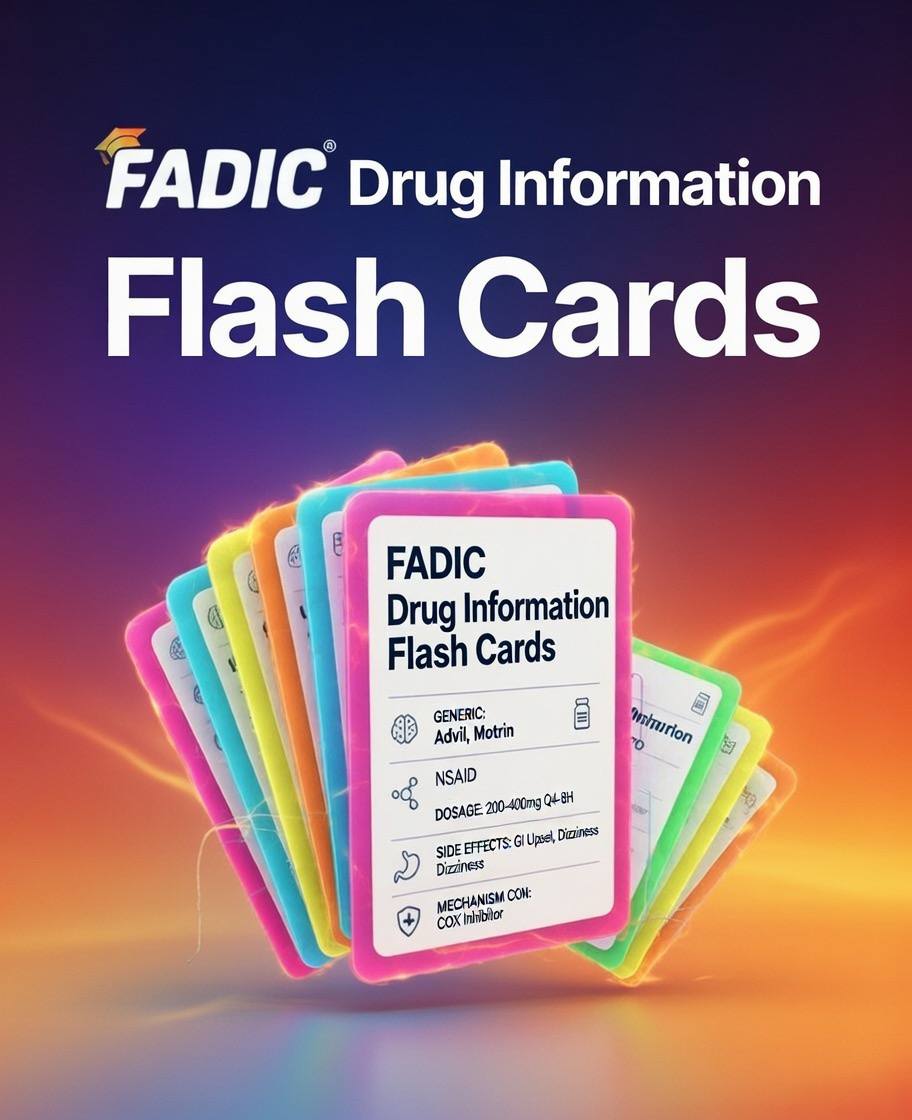
FADIC Drug Information Flash Cards
Pharmacology is the branch of medicine concerned with drugs' uses, effects, and modes of action. It studies how different chemicals affect biological systems and incorporates knowledge and skills from several basic science disciplines, including physiology, biochemistry, and cellular and molecular biology. Pharmacy Top 200 Drug Information Flashcards provide concise but pertinent information on commonly prescribed drugs. Learn More Now!!

Duration
Top Drug Cards

Language
English

Year
2018
Overview

FADIC Drug Information Monographs Flash Cards
Master Pharmacology with FADIC Drug Information Flashcards: The Ultimate Clinical Guide for Healthcare Professionals
By Dr Rasha Abdelsalam Elshenawy
May 2018
Introduction:
- Pharmacology is the branch of medicine concerned with drugs’ uses, effects and modes of action.
- It studies how different chemicals affect biological systems and incorporates knowledge and skills from several basic science disciplines, including physiology, biochemistry, and cellular and molecular biology.
- As more medicines become available, pharmacology has become more critical used.
- It is essential to determine the potential interactions caused by patients taking multiple prescribed and over-the-counter medications.
- pharmacology is vital to medical support staff because it is essential in keeping a patient safe during treatment.
- In this book, we introduce Pharma Flash Cards as a quick and easily accessible tool for physicians, pharmacists and all health care providers, with content covering a broad range of pharmacology branches.
Introduction: The Challenge of Modern Pharmacology
- In the rapidly evolving world of medicine, pharmacology stands as the bridge between basic science and clinical practice. It is the discipline that connects physiology, biochemistry, and molecular biology to the tangible outcome of patient health. However, for medical students, pharmacists, and practicing physicians, the sheer volume of drug information is overwhelming.
- With thousands of chemical entities, complex dosing regimens, black box warnings, and intricate pharmacokinetic profiles, the risk of medication errors is real. It is no longer enough to simply memorize a brand name; healthcare providers must understand off-label indications, adjustments for renal impairment, and subtle look-alike sound-alike (LASA) confusion risks.
- Enter the FADIC Drug Information Monographs Flash Cards. Authored by Dr. Rasha Abdelsalam Elshenawy, this resource is not just a study tool—it is a clinical survival guide. Designed to streamline the Pharmacists’ Patient Care Process (PPCP), these flashcards transform dense textbook data into high-yield, visual, and immediately applicable clinical knowledge.
Why You Need the FADIC Drug Information Flashcards
1. Bridging the Gap Between Theory and Practice
- Historically, the pharmacist’s role was centered on dispensing. Today, pharmacists are integral members of the healthcare team, often serving as the primary barrier between a patient and a potential adverse drug event. The FADIC Flashcards are designed to support this modern role by providing “at-a-glance” access to critical data.
2. Visual Learning for Retention
Cognitive science tells us that visual data is processed 60,000 times faster than text. The FADIC cards utilize a structured layout that allows you to scan for:
Therapeutic Category: Instantly identify if a drug is a Calcium Channel Blocker or a Beta-Blocker.
Dosing: Clear breakdowns for adults, geriatrics, and pediatrics.
Safety: Highlighted warnings about pregnancy risks and drug interactions.
3. Comprehensive Coverage
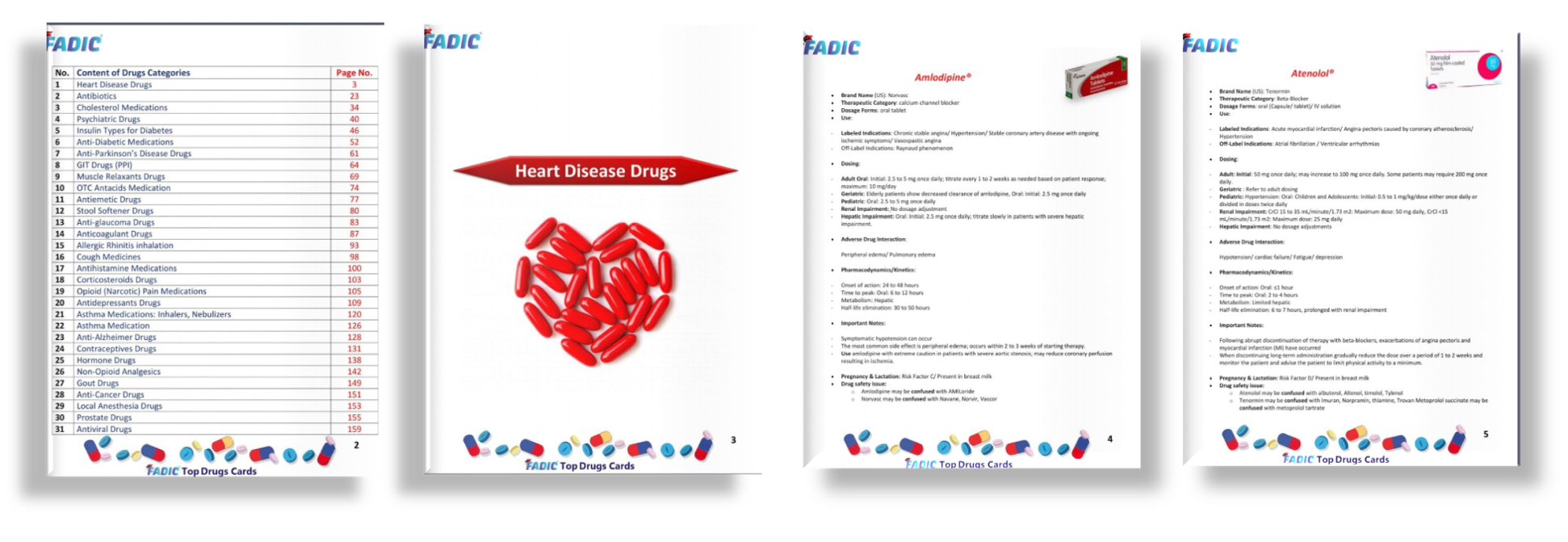
- This is not a limited set. The collection spans over 150 pages of content covering the most prescribed and clinically significant drugs across the medical spectrum . From Heart Disease Drugs on page 3 to Antiviral Drugs on page 159, this collection is a complete library in the palm of your hand .
Deep Dive: Inside the Heart Disease Section
A Preview of the Clinical Depth Provided in These Cards
- To demonstrate the value of this collection, let’s explore the Heart Disease Drugs section (Page 3) . This section alone offers a masterclass in cardiology pharmacotherapy. The cards don’t just list the drug; they provide the nuance required for safe prescribing.
Amlodipine (Norvasc): The Calcium Channel Blocker Standard
The Amlodipine card is a perfect example of the detail provided.
Indications: It covers labeled uses like Chronic Stable Angina and Hypertension, but crucially, it also lists Raynaud phenomenon as an off-label indication . This is the kind of clinical pearl that separates a novice from an expert.
Dosing Nuances: The card details the standard adult starting dose of 2.5 to 5 mg once daily, titrating up to a maximum of 10 mg/day . However, it importantly notes that for geriatric patients or those with hepatic impairment, the clearance is decreased, requiring a conservative start at 2.5 mg .
Safety Alerts: It warns of peripheral edema, which typically occurs within 2 to 3 weeks of starting therapy . It also includes a critical LASA warning: Amlodipine may be confused with Amiloride .
Atenolol (Tenormin): Managing Beta-Blockade
The Atenolol card highlights the importance of tapering.
Black Box Warning Context: The card explicitly states that following abrupt discontinuation, exacerbations of angina pectoris and myocardial infarction have occurred . It advises a gradual reduction over 1 to 2 weeks .
Renal Adjustments: Unlike some drugs processed by the liver, Atenolol requires significant adjustment in kidney disease. The card provides the specific CrCl cutoffs: if CrCl is 15-35 mL/min, the max dose is 50 mg; if below 15 mL/min, the max is 25 mg .
Safety Profile: It warns of confused names like Albuterol or Tylenol—errors that could be fatal .
Carvedilol (Coreg): The Dual Action Blocker
For heart failure patients, Carvedilol is a cornerstone therapy.
Mechanism: The card classifies it as a Beta-Blocker with Alpha-Blocking activity , explaining its unique hemodynamic profile.
Administration Tips: A critical clinical note included is that Carvedilol should be taken with food to minimize the risk of orthostatic hypotension .
Dosing Strategy: It outlines the specific titration for Heart Failure with reduced Ejection Fraction (HFrEF), starting at a micro-dose of 3.125 mg twice daily .
Contraindications: It explicitly notes that in severe hepatic impairment, the use of Carvedilol is contraindicated .
Benazepril (Lotensin): ACE Inhibitor Protocols
Indications: Covers Hypertension (labeled) and Heart Failure (off-label) .
Pregnancy Warning: The card includes a stark warning to discontinue as soon as pregnancy is detected, classifying it as Risk Factor D .
Geriatric Care: It notes that ACE inhibitors may be preferred agents in elderly patients with CHF and diabetes mellitus, providing context for drug selection .
Chlorthalidone: The Thiazide-Like Diuretic
Dosing Limits: The card specifies a max dose of 200 mg/day for edema but a much lower target of 50 mg/day for hypertension .
Electrolyte Monitoring: It lists specific risks: Hypokalemia, hypochloremic alkalosis, hypomagnesemia, and hyponatremia .
Allergy Alerts: It notes increased risk in patients with a history of bronchial asthma .
Clonidine (Catapres/Kapvay): Beyond Hypertension
Versatility: This card demonstrates the drug’s wide range, from Hypertension (immediate release) to ADHD (extended release) and Pain Management (epidural) .
Off-Label Uses: It includes fascinating off-label uses such as Clozapine-induced sialorrhea (excessive drooling) and Conduct Disorder .
Pediatric Safety: It provides specific weight-based dosing for ADHD in children (starting at 0.05 mg at bedtime) .
Diltiazem (Cardizem): Rate Control and More
Indications: Includes management of chronic stable angina and hypertension .
Off-Label Pearls: Did you know Diltiazem is used off-label for Anal Fissures? The FADIC card includes this, along with Atrial Fibrillation .
Kinetics: It details the onset of action (30-60 minutes) and the extensive first-pass metabolism that results in 40% bioavailability .
Comprehensive Therapeutic Categories
The Heart Disease section is just the beginning. The FADIC Drug Information Flashcards cover the entire pharmacological landscape. Based on the Index , the collection includes:
1. Anti-Infective Agents
- Antibiotics (Page 23): Essential coverage of spectrums of activity, resistance patterns, and renal dosing adjustments.
- Antiviral Drugs (Page 159): Critical for managing modern viral pathogens.
2. CNS and Psychiatric Medicine
- Psychiatric Drugs (Page 40): Navigating the complex world of antipsychotics and mood stabilizers.
- Antidepressants (Page 109): SSRIs, SNRIs, and TCAs with washout periods and serotonin syndrome warnings.
- Anti-Alzheimer Drugs (Page 128): Managing cognitive decline.
- Anti-Parkinson’s Disease Drugs (Page 61): Dopamine agonists and levodopa protocols.
3. Endocrine and Metabolic
- Insulin Types (Page 46) & Anti-Diabetic Medications (Page 52): From rapid-acting insulins to the newest oral agents.
- Cholesterol Medications (Page 34): Statins, fibrates, and absorption inhibitors.
- Hormone Drugs (Page 138) & Contraceptives (Page 131).
4. Pain Management and Anesthesia
- Opioid (Narcotic) Pain Medications (Page 105): Critical safety data on morphine equivalents and respiratory depression.
- Non-Opioid Analgesics (Page 142): NSAIDs and Acetaminophen safety.
- Local Anesthesia Drugs (Page 153): Esters vs. Amides.
- Muscle Relaxants (Page 69).
5. Respiratory and Allergy
- Asthma Medications (Page 120, 126): Inhalers, nebulizers, and stepwise management.
- Allergic Rhinitis (Page 93) & Antihistamines (Page 100).
- Cough Medicines (Page 98).
6. Gastrointestinal (GIT)
- PPIs (Page 64): Proton Pump Inhibitors and long-term risks.
- Antiemetics (Page 77), Stool Softeners (Page 80), and OTC Antacids (Page 74).
7. Specialized Care
- Anticoagulant Drugs (Page 87): Warfarin monitoring and DOACs.
- Anti-Cancer Drugs (Page 151): Chemotherapy basics.
- Anti-Glaucoma Drugs (Page 83).
- Prostate Drugs (Page 155) & Gout Drugs (Page 149).
The Anatomy of a FADIC Flashcard
What makes these cards superior to a standard textbook? It is the Structured Information Architecture. Every card follows a consistent, reliable format that ensures you find the answer you need in seconds.
1. Brand and Generic Identification
Each card clearly displays the Brand Name (US) (e.g., Lotensin) alongside the Generic Name (e.g., Benazepril) . This aids in preventing dispensing errors when prescriptions are written with varying terminologies.
2. Therapeutic Hierarchy
The card immediately classifies the drug. For example, Clonidine is identified as an Alpha2-Adrenergic Agonist . This helps the user instantly recall the mechanism of action and expected side effect profile (like sedation or dry mouth).
3. Labeled vs. Off-Label Indications
This is a standout feature. Most sources only list FDA-approved uses. FADIC cards list Off-Label Indications which reflect real-world clinical practice. For instance, seeing Calcium nephrolithiasis (kidney stones) as an off-label use for Chlorthalidone provides immediate clinical context for a prescription that might otherwise look confusing.
4. Precision Dosing
The cards don’t just give a single number. They break dosing down by:
- Adults: Initial vs. Maintenance vs. Maximum daily dose.
- Pediatrics: Weight-based dosing (mg/kg) where applicable, such as the 0.2 mg/kg dosing for Benazepril in children .
- Geriatrics: Specific warnings for the elderly, such as the decreased clearance noted for Amlodipine .
5. Organ Impairment Adjustments
Crucial for hospital pharmacists and nephrologists. The cards explicitly state if dosage adjustment is needed for Renal or Hepatic impairment.
- Example: For Carvedilol, the card warns that severe hepatic impairment is a contraindication .
- Example: For Chlorthalidone, it clarifies that no renal dosage adjustment is needed, which is distinct from many other diuretics .
6. Pharmacodynamics & Kinetics
Understanding how a drug moves through the body is vital for timing.
- Onset of Action: Know when to expect results (e.g., Diltiazem acts in 30-60 mins ).
- Half-Life: Critical for determining dosing intervals (e.g., Amlodipine’s long half-life of 30-50 hours supports once-daily dosing ).
- Metabolism: Hepatic vs. Renal pathways are clearly identified.
7. Safety Guardrails (Look-Alike Sound-Alike)
Medication errors often stem from confusing names. Each card features a “Drug Safety Issue” section.
- Example: DilTIAZem may be confused with DiazePAM or Dilantin . Highlighting these risks saves lives.
Who Should Use These Flashcards?
For Pharmacy Students & Interns
- Pharmacology is often the hardest subject in pharmacy school. The transition from memorizing chemical structures to making clinical decisions is difficult. These cards serve as the perfect revision tool for board exams (NAPLEX, PEBC, etc.). They distill the “must-know” facts from the “nice-to-know” fluff.
For Practicing Pharmacists
- Whether you are in retail or a hospital setting, you are the final check before a patient receives medication. When you receive a prescription for Clonidine 0.05 mg, you need to quickly verify if that’s appropriate for a 30kg child with ADHD . These cards allow you to verify dosing, check for off-label validity, and counsel patients on side effects like drowsiness without digging through a massive reference book.
For Nurses and Physicians
- Quickly verify compatibility, administration requirements (e.g., taking Carvedilol with food ), and monitor for adverse effects like the cough associated with ACE inhibitors or the peripheral edema associated with Calcium Channel Blockers .
About FADIC: Trust and Authority
The FADIC (First Arabian Drug Information Center) is a leader in providing evidence-based medical information. Authored by Dr. Rasha Abdelsalam Elshenawy, the content is curated with a focus on clinical applicability.
FADIC goes beyond just flashcards. The ecosystem includes:
The FADIC School of Research: Helping professionals publish their work.
FADIC Blog & News Network: Keeping you updated on the latest in pharmacotherapy.
FADIC Drug Information Program: A comprehensive course for those who want to specialize in drug information centers .
When you use FADIC Flashcards, you aren’t just reading a PDF; you are accessing a verified, expertly curated database used by professionals globally to improve patient outcomes.
Frequently Asked Questions (FAQ)
- Q: Are these flashcards suitable for the US exams? A: Yes, the cards include US Brand Names (e.g., Norvasc, Coreg, Lotensin) and follow standard therapeutic categorization , making them excellent for US board prep.
- Q: Do the cards cover pediatric dosing? A: Absolutely. Where applicable, specific pediatric dosing regimens are provided, such as the mg/kg dosing for Atenolol and Benazepril in children .
- Q: Is renal dosing included? A: Yes. The cards distinguish between drugs that need adjustment (like Atenolol) and those that do not (like Amlodipine or Chlorthalidone) .
- Q: How do these help with patient safety? A: By including “Look-Alike Sound-Alike” (LASA) warnings on every card (e.g., confusing Hydroxyzine with Hydralazine, or Amlodipine with Amiloride), these cards directly address one of the most common causes of medication errors .
- Q: Can I use these for patient counseling? A: Yes. The “Important Notes” and “Adverse Drug Interaction” sections provide the exact talking points you need to warn patients about side effects like orthostatic hypotension or photosensitivity .
Take the Next Step in Your Clinical Journey
- Don’t let the complexity of pharmacology slow down your career or compromise patient care. Equip yourself with the tool that turns data into actionable knowledge.
- The FADIC Drug Information Flashcards are more than a study aid; they are a commitment to excellence in pharmacy practice. Whether you are revising for an exam or double-checking a dose in the ICU, these cards are the reliable partner you need.
Ready to Master Pharmacology?
- Enhance your clinical skills, improve your efficiency, and ensure patient safety today.
- [Download the FADIC Drug Information Flashcards Now] Join the community of pharmacists who rely on FADIC for trusted, evidence-based drug information.
Drug Information Flash Cards Chapters
📑 Table of Content 📥
📑 Sample Chapter 📥
- Heart Disease Drugs
- Antibiotics
- Cholesterol Medications
- Psychiatric Drugs
- Insulin Types for Diabetes
- Anti-Diabetic Medications
- Anti-Parkinson’s Disease Drugs
- GIT Drugs (PPI)
- Muscle Relaxants Drugs
- OTC Antacids Medication
- Antiemetic Drugs
- Stool Softener Drugs
- Anti-glaucoma Drugs
- Anticoagulant Drugs
- Allergic Rhinitis inhalation
- Cough Medicines
- Antihistamine Medications
- Corticosteroids Drugs
- Opioid (Narcotic) Pain Medications
- Antidepressants Drugs
- Asthma Medications: Inhalers, Nebulizers
- Asthma Medication
- Anti-Alzheimer Drugs
- Contraceptives Drugs
- Hormone Drugs
- Non-Opioid Analgesics
- Gout Drugs
- Anti-Cancer Drugs
- Local Anaesthesia Drugs
- Prostate Drugs
- Antiviral Drugs
Drug Information Flash Cards Chapters (Summarised Info-graphics):

- Over the past few decades, the health care needs of our population changed along with the role of pharmacists.
- Historically, the pharmacists’ role in healthcare was centred on dispensing medications. In addition, they have to ensure the accurate delivery of drugs to patients.
- Today, pharmacists are an integral part of our health care team.
- They are also considered the most accessible health care professionals.
- This approach enables them to perform their pharmacists’ patient care process (PPCP).
- This process contains items such as collect, access, plan, implement and follow-up.
- It’s done to evaluate the appropriateness & effectiveness of medications & to obtain patient feedback.
- Additionally, pharmacists advise other health professionals concerning medication therapy decisions.
- Moreover, inform them about the composition of drugs and their physicochemical and biological properties.
Read More Now from FADIC Article, from This LINK.
Related Resources:
- Join FADIC Drug Information Program to learn more.
- FADIC Blog Learn how to deal with the Public with trusted and evidence-based information.
- ALL FADIC Programs & Mini-Courses, stay tuned to FADIC Programs.
- FADIC News Network “FNN” send every business day an email with the news.
- Podcast of FADIC help you to learn from others’ experiences in clinical practice.
- It is now time to share the publication process. Join the FADIC School of Research.
Download Now from FADIC Website:
- Download Now the info-graphs of Certification/ Grow pharmacist from this LINK.
- Download Now The info-graphs of Anticoagulant,from this LINK.
Hashtags
#drug information handbook pdf #Monographs #drug information book
#drug information، drug information resources #drug information handbook
#TopDrugs #drug information centre, #Top 200 Drug Information #Flashcards
#معلومات الادويه#مركز المعلومات الدوائيه #dic pharmacist، dic #مركز المعلومات الدوائية #Pharmacology #DrugInformation #PharmacyStudent #ClinicalPharmacy #NAPLEX #FADIC #Top200Drugs #MedicationSafety #PharmacySchool #MedicalFlashcards #CardiologyDrugs #Antibiotics #PatientSafety #Flashcards #medicationflashcards #FADIC #flash dic
Reviews
الكتاب جدا جميل ومختصر وواضح المجهود بتنسيقة وبالمحتوي
Pharmacist